The Christmas season, the holiday season, or simply the holidays is an annual festive period that surrounds Christmas and various other holidays. It is generally considered to run from late November to early January. Its relation to Christmas in official use by schools and governments has resulted in controversy. It incorporates a period of shopping which comprises a peak season for the retail sector (the "Christmas shopping season"), and a period of sales at the end of the season (the "January sales").
The exact definition, name, and celebratory method of the period varies from culture to culture. The majority of Christian denominations in the U.S. celebrate Christmas beginning with Advent between November 27 and December 3 and ending after the Epiphany on January 6. Eastern Orthodox churches observe the Nativity Fast from September 1 through December 24 and the holiday season lasts through January 7th. In medieval pagan cultures, the season began after All Hallow's Eve (Halloween) and lasted through the Twelfth Night. The season in the United States encompasses at very least Christmas Eve through New Year's Day (the usual period for school vacations) but is now generally considered to begin with Thanksgiving and end after New Year's Day. The U.S. Fire Administration defines the "Winter Holiday Season" as the period from December 1 to January 7. Some stores and shopping malls advertise their Christmas merchandise beginning after Halloween or even in late October, alongside Halloween items.
The precise definition of feasts and festival days that are encompassed by the Christmas and holiday season has become controversial over recent decades. Traditionally, the only holidays included in the "season" in the U.S. were Christmas Eve, Christmas Day, New Year's Eve, New Year's Day and Epiphany. In recent times, this definition has begun to expand to include Hanukkah, Kwanzaa, Thanksgiving and Black Friday. Due to the phenomenon of Christmas creep and the informal inclusion of Thanksgiving, the Christmas and holiday season has begun to extend earlier into the year.
Wikipedia tells us that:A sandwich is a food item, often consisting of two or more slices of bread with one or more fillings between them,or one slice of bread with a topping or toppings, commonly called an open sandwich. Sandwiches are a widely popular type of lunch food, typically taken to work or school, or picnics to be eaten as part of a packed lunch. They generally contain a combination of salad vegetables, meat, cheese, and a variety of sauces. The bread can be used as it is, or it can be coated with any condiments to enhance flavor and texture. They are widely sold in restaurants and cafes. But a sandwich in the U.S. is sooooo much more than that. It can be a regional identity (Philly Cheesesteaks, New Orleans Po' Boys) or a family tradition. The names may be different in different areas (hoagies, subs, po'boys...) even when the ingredients are the same. There is always that one sandwich that is your absolute favorite. Some people are mayonaise traditionalists, others like only mustards. Lettuce? Cole slaw? Pickles? Heated arguments can arise over sandwich loyalties. And really - a slice of ham and a slice of cheese with mayo and a piece of lettuce doesn't even come close to being a real sandwich. Real sandwiches require artistry.
Serious Eats produced their 2010 version of The Best Sandwiches in America. Once you take a look at the slide show and read the descriptions you'll want to run out and have one of each.
Here are just some of the more well-known sandwiches from the U.S. that you have to know about:
Beef on weck (Buffalo) roast beef and horseradish on a Kaiser roll topped with pretzel salt and caraway seeds
Cuban sandwich (Cuba/South Florida) ham, Swiss cheese, pickled peppers, and roasted pork
Dagwood, distinguished by size more than contents. Named after the cartoon character who loved large sandwiches.
French dip sandwich, also known as a beef dip, is a hot sandwich consisting of thinly sliced roast beef (or, sometimes, other meats) on a "French roll" or baguette. It is most commonly served au jus.
Grilled cheese, fried or broiled sandwich consisting of melted cheese between slices of buttered bread.
Hamburger, ground meat patty in a round bun, usually served with some combination of tomato, onion, lettuce, pickle, mustard, and mayonnaise
Horseshoe ( Springfield, IL) an open sandwich topped with French fries and cheese sauce
Peanut butter and jelly, a chilhood favorite and general comfort food little understood outside of North America
Rachel, also referred to as the "Turkey Reuben"; coleslaw with Swiss cheese, 1000 Island or Russian dressing, and sliced turkey
Reuben, sauerkraut with Swiss cheese, 1000 Island or Russian dressing, and corned beef or pastrami
Roast beef, made with roast beef, tomatoes, lettuce, cheese, and mayonnaise or horseradish sauce.
Sloppy Joe, hot ground beef in a flavorful and sloppy sauce.
Submarine, also known as sub, grinder, hero, hoagie, Italian sandwich, po' boy, wedge, zep, torpedo or roll. Can contain an infinite variety of ingredients, although each area swears that their version is the only authentic one.
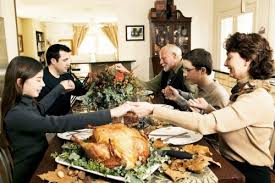
In 1621, the Plymouth colonists and Wampanoag Indians shared an autumn harvest feast that is acknowledged today as one of the first Thanksgiving celebrations in the colonies. For more than two centuries, days of thanksgiving were celebrated by individual colonies and states. It wasn't until 1863, in the midst of the Civil War, that President Abraham Lincoln proclaimed a national Thanksgiving Day to be held each November. Congress finally made Thanksgiving Day an official national holiday in 1941. Today Thanksgiving is still about giving thanks, but wouldn't be Thanksgiving without family, turkey, cranberry sauce, pumpkin pie and football
Here are some interesting Thanksgiving facts from the History Channel -
The American Automobile Association (AAA) estimated that 38.4 million Americans traveled 50 miles or more from home over the Thanksgiving holiday weekend in 2009.
According to the U.S. Census Bureau, Minnesota is the top turkey-producing state in America, with a planned production total of 45.5 million in 2009. Just six states—Minnesota, North Carolina, Missouri, Virginia, and California—will probably produce two-thirds of the estimated 2750 million birds that will be raised in the U.S. this year.
In a survey conducted by the National Turkey Federation, nearly 88 percent of Americans said they eat turkey at Thanksgiving. The average weight of turkeys purchased for Thanksgiving is 15 pounds, which means some 690 million pounds of turkey were consumed in the U.S. during Thanksgiving in 2007.
Cranberry production in the U.S. was approximately 709 million pounds in 2009. Wisconsin, Massachusetts, New Jersey, Oregon and Washington are the top cranberry growing states.
Illinois, California, Pennsylvania and New York are the major pumpkin growing states, together they produced 1.1 billion pounds of pumpkin in 2008, with a combined value of $141 million.
The sweet potato is most plentifully produced in North Carolina, which grew 874 million pounds of the popular Thanksgiving side dish vegetable in 2008. Other sweet potato powerhouses included California and Mississippi which produced 437 million pounds and 335 million pounds, respectively.
The first time the Detroit Lions played football on Thanksgiving Day was in 1934, when they hosted the Chicago Bears at the University of Detroit stadium, in front of 26,000 fans. The NBC radio network broadcast the game on 94 stations across the country--the first national Thanksgiving football broadcast. Since that time, the Lions have played a game every Thanksgiving (except between 1939 and 1944); in 1956, fans watched the game on television for the first time.
“Thanksgiving Facts.” 2010. The History Channel website. nov 22 2010, 10:08 http://www.history.com/topics/thanksgiving-facts.
John Fitzgerald Kennedy, the thirty-fifth president of the United States of America, was in office only two years and ten months before he was shot to death on November 22, 1963. Every American who was alive on that November day remembers where he/she was and what they were doing when they heard the tragic news of Kennedy's assassination. He is remembered as a charismatic, optimistic leader who believed we could solve problems if we put our country's interests before our own and worked together.
On the 40th anniversary of his death (2003) the Dallas Morning News published a special report, saying, " The assassination of President John F. Kennedy remains a defining moment in the history of the United States. This special report is designed to put the story in its proper historical context and track current coverage of the 40th anniversary of the assassination." You must register with your name, email address, mailing address, and year of birth. But please don't let that stop you, because the primary source material here is incredible. View original newspapers articles, listen to radio clips, and watch television news snippets, all from local Dallas media.
At the History Place you can browse through a four-part annotated photo gallery of Kennedy's life is divided into four sections: Early Years, War Hero, Politician and President. As you progress through the gallery, click on the thumbnail photos for a larger view.
The Macy's Parade in New York City is a favorite Thanksgiving day tradition.
Originally known as Macy's Christmas Parade—to signify the launch of the Christmas shopping season—the first Macy's Thanksgiving Day Parade took place in New York City in 1924. It was launched by Macy's employees and featured animals from the Central Park Zoo. Today, some 3 million people attend the annual parade and another 44 million watch it on television.
Tony Sarg, a children's book illustrator and puppeteer, designed the first giant hot air balloons for the Macy's Thanksgiving Day Parade in 1927. He later created the elaborate mechanically animated window displays that grace the façade of the New York store from Thanksgiving to Christmas.
Snoopy has appeared as a giant balloon in the Macy's Thanksgiving Day Parade more times than any other character in history. As the Flying Ace, Snoopy made his sixth appearance in the 2006 parade.
“Thanksgiving Facts.” 2010. The History Channel website. nov 22 2010, 10:08 http://www.history.com/topics/thanksgiving-facts.
Written in 1620 by the Mayflower passengers (who later were called Pilgrims), the Mayflower Compact was the first document of self-government in the colonies of the New World. Signed by all the adult male passengers of the Mayflower, it was based on the Covenant they lived by in Leyden, England before setting sail. It is hailed as the first democratic government created by voluntary agreement among men of equal rights. There was, of course, room for improvement. The Compact was signed by all the men on board - including the indentured servants - promising to abide by laws that would be drawn up and agreed upon by all male members of the community. The women were not allowed to participate in the governing process. However, according to the Mayflower Compact, a self-governing body rules for the greater good; and that principle of government has had great iimpact on the North American continent to this day.
...do
by this presence solemnly & mutually in thepresence of God, and
one of another, covenant, & combine our selves together into a
civil body politick; forour better ordering, & preservation &
furtherance of theends aforesaid; and by virtue hereof, to enact,
constitute, and frame such just & equal laws, ordinances,
Acts, constitutions, & offices, from time to time, as shall be thought
most meet & convenient for thegeneral good of thecolony: unto
which we promise all due submission and obedience.
If you look at a transcription of the Mayflower Compact, without changes to spelling or punctuation, you can appreciate how much English has changed since 1620. In general, the MayflowerHistory site is an excellent place to learn more about the Mayflower settlers, their first Thanksgiving and what they found when they arrived in the New World.
On the 11th hour of the 11th day of the 11th month of 1918, an armistice, or temporary cessation of hostilities, was declared between the Allied nations and Germany in the First World War, then known as "the Great War." Commemorated as Armistice Day beginning the following year, November 11th became a legal federal holiday in the United States in 1938. In the aftermath of World War II and the Korean War, Armistice Day became Veterans Day, a holiday dedicated to American veterans of all wars. Bagpipes, parades, American flags and marching veterans are all part of Veterans' Day celebrations in big cities and small towns across the country. It would be hard to find a family, much less a community, without a veteran to remember and honor. The United States of America will never forget that Freedom is not free.
The History Channel has several Veterans' Day videos available, including the History of Veterans' Day.
November is Native American Heritage Month. What started at the turn of the century as an effort to gain a day of recognition for the significant contributions the first Americans made to the establishment and growth of the U.S., has resulted in a whole month being designated for that purpose.In 1990 President George H. W. Bush approved a joint resolution designating November 1990 "National American Indian Heritage Month." Similar proclamations, under variants on the name (including "Native American Heritage Month" and "National American Indian and Alaska Native Heritage Month") have been issued each year since 1994. Check out the information on the official Native American Heritage month site as well as at the Smithsonian.
This Smithsonian video gives a glimpse of Family Day Celebration 2009 and a thoughtful explaination of the role of tradition and traditional arts.
Most of theUnited Statesbegins Daylight Saving Time at 2:00 a.m. on the second Sunday in March and reverts to standard time on the first Sunday in November. In the U.S., each time zone switches at a different time. Children (and many adults) use the memory aid "Spring ahead, Fall back" to help remember the direction of the clock changes. During DST, clocks are turned forward an hour in the spring, effectively moving an hour of daylight from the morning to the evening.
The official spelling is Daylight Saving Time, not Daylight SavingS Time.
Saving is used here as a verbal adjective (a participle). It modifies time and tells us more about its nature; namely, that it is characterized by the activity of saving daylight. It is a saving daylight kind of time. Because of this, it would be more accurate to refer to DST as daylight-saving time. Similar examples would be a mind-expanding book or a man-eating tiger. Saving is used in the same way as saving a ball game, rather than as a savings account.
Nevertheless, many people feel the word savings (with an 's') flows more mellifluously off the tongue. Daylight Savings Time is also in common usage, and can be found in dictionaries.
Adding to the confusion is that the phrase Daylight Saving Time is inaccurate, since no daylight is actually saved. Daylight Shifting Time would be better, and Daylight Time Shifting more accurate, but neither is politically desirable.
Learn much more about Daylight Saving Time in this 8-page presentation. On page 3 you will find out how DST helped avoid a terrorist attack, why there are sometimes riots when the clock changes, and how birth order in twins can be changed by DST time shifts. On page 8 you can see that Venezuela is one of the countries that has never implemented DST.
A Fun Fact: In the U.S., Arizona doesn’t observe Daylight Saving Time, but the Navajo Nation (parts of which are in three states) does. However, the Hopi Reservation, which is entirely surrounded by the Navajo Nation, doesn’t observe DST. In effect, there is a donut-shaped area of Arizona that does observe DST, but the “hole” in the center does not.
Excerpts from one of the most famous American speeches. Martin Luther King's I Have a Dream Speech, given in Washington D.C. on August 28th, 1963. Hardly any U.S. citizen can hear the words "I have a dream." and not think of this speech. It has become part of the national culture.
It’s one of a kid’s favorite parts of Halloween. There’s no feeling quite like waiting for a stranger to open his or her door so you can scream the words “trick or treat.”
But why do we say it? What does it actually mean?
The practice of dressing in costume and asking for treats from your neighbors dates back to the Middle Ages. But back then it wasn’t a game.
During the medieval practice of souling, poor people would make the rounds begging for food. In return, they offered prayers for the dead on All Souls Day. (What does the “een” in “Halloween” mean exactly? The answer lies here.)
Modern trick or treating is a custom borrowed from guising, which children still do in some parts of Scotland. Guising involves dressing in costume and singing a rhyme, doing a card trick, or telling a story in exchange for a sweet. The Scottish and Irish brought the custom to America in the 19th century.
The earliest reference of the term “trick or treat” in print was in 1927, in Alberta, Canada. It appears as if the practice didn’t really take hold in the U.S. until the mid-1930s, where it was not always well received. The demanding of a treat angered or puzzled some adults.
Supposedly, in a Halloween parade in 1948 in New York, the Madison Square Boys Club carried a banner sporting the message “American Boys Don’t Beg.”
Trick or treating today is now practiced in northwestern and central Mexico. But instead of saying “trick or treat,” children ask, ¿me da mi calaverita?, which means “can you give me my little skull?”
This week thousands of Americans will scoop out the flesh of a gourd, crudely carve a haunting face into its rind, and stick a candle inside. Then the jack-o’-lanterns will proudly be displayed on porches and stoops. Who or what is this wacky tradition named after?
The British can claim ownership of the original use of the phrase “jack-o’-lantern.” In the 17th century, it referred to a night watchman, a man who literally carried a lantern.
But it was also a nickname for strange, flickering lights seen at night over wetlands, or peat bogs, and mistaken to be fairies or ghosts. This natural phenomenon is also called ignis fatuus, which means “fool’s fire,” and will o’ the wisp.
Eventually what was called a “turnip lantern” became known as a jack-o’-lantern. Young boys used these hollowed-out and lit-up gourds to spook people.
Legend has it that this use of jack-o’-lantern was named after a fellow named StingyJack, who thought he had tricked the devil. But the devil had the last laugh, condemning Jack to an eternity of wandering the planet with only an ember of hellfire for light.
Irish immigrants brought the jack-o’-lantern custom to North America, which is where pumpkins were first used to make the Halloween decorations.
Impress fellow partiers this weekend with this fact: a jack-o’-lantern is also the name for an orange fungus. The mushroom Omphalotus olearius is found at the base of hardwood tree stumps. It is extremely poisonous.
What have you read - and who have you read to today??
Today we live in a world full of digital information. Yet reading has never been more important, for we know that for young people the ability to read is the door opener to the 21st century: to hold a job, to understand their world, and to know themselves. That is why we are asking you to join our Global Literacy Call to Action: We call this campaign: “Read Every Day. Lead a Better Life.” We are asking parents, teachers, school and business leaders, and the general public to support their children’s right to read for a better life in the digital world of the 21st century.
Here is what we believe about reading in the second decade of the 21st century.
We call this The Reading Bill of Rights:
WE BELIEVE that literacy – the ability to read, write and understand – is the birthright of every child in the world as well as the pathway to succeed in school and to realize a complete life. Young people need to read nonfiction for information to understand their world, and literature for imagination to understand themselves.
WE BELIEVE that the massive amounts of digital information and images now transmitted daily make it even more important for a young person to know how to analyze, interpret and understand information, to separate fact from opinion, and to have deep respect for logical thinking.
WE BELIEVE that literature and drama, whether on printed pages, screens, on stage or film, help young people experience the great stories of emotion and action, leading to a deeper understanding of what it means to be truly human. Without this literacy heritage, life lacks meaning, coherence and soul.
WE BELIEVE every child has a right to a “textual lineage” – a reading and writing autobiography which shows that who you are is in part developed through the stories and information you’ve experienced. This textual lineage will enable all young people to have a reading and writing identity which helps them understand who they are and how they can make their lives better. In short, “You Are What You Read.”
WE BELIEVE every child should have access to books, magazines, newspapers, computers, e-readers, and text on phones. Whatever way you read, you will need to figure out what the facts are or what the story tells you. No matter how and where you get access to ideas, you will need the skills of reading to understand yourself and your world.
WE BELIEVE that reading widely and reading fluently will give children the reading stamina to deal with more challenging texts they will meet in college, at work and in everyday life. And every child should be able to choose and own the books they want to read, for that choice builds literacy confidence – the ability to read, write and speak about what they know, what they feel, and who they are.
WE BELIEVE that every child has the right to a great teacher who will help them learn to read and love to read. Children need teachers who provide intentional, focused instruction to give young people the skills to read and interpret information or understand great stories they will encounter throughout life.
WE BELIEVE that in the 21st century, the ability to read is necessary not only to succeed but to survive—for the ability to understand information and the power of stories is the key to a life of purpose and meaning.